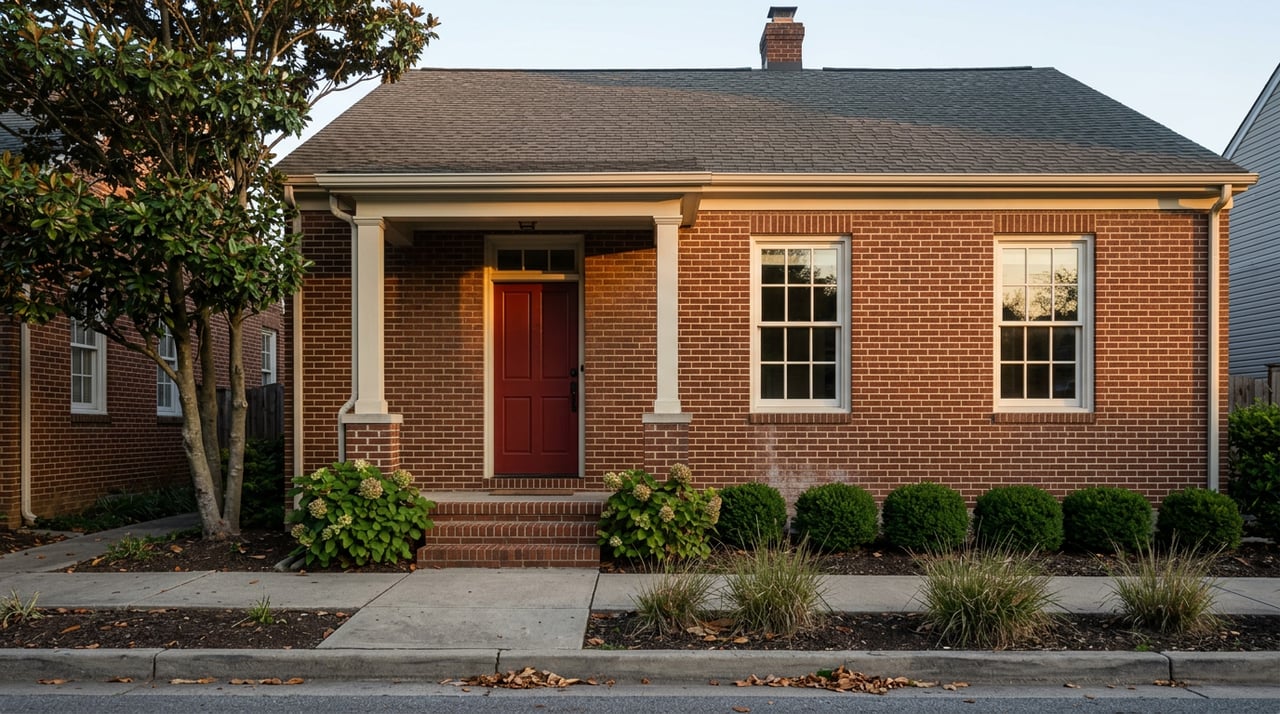
A buyer we spoke with this spring was choosing between two three-bedroom houses less than half a mile apart. One sat on Washington Street inside Harpers Ferry's historic core. The other was a few blocks over in Bolivar, the community that shares Harpers Ferry's zip code, its water and sewer district, and, from the sidewalk, its brick-and-frame architecture. Same era. Same square footage, give or take. Almost the same price.
What she hadn't priced in was the window.
Both houses needed new windows within the next five years. On the Bolivar house, that's a phone call to a contractor. On the Washington Street house, it's an application to the Harpers Ferry Historic Landmarks Commission, a wait for the second Wednesday of the month, and a set of guidelines that specify how storm windows should be glazed and why historic window openings can't simply be enlarged or bricked in. It's not a dealbreaker. It's a line item that never shows up on a listing sheet, and it's a big part of why the market data for these two adjoining communities has started to diverge in ways a portal median won't explain on its own.
The line you can't see in a listing photo
Harpers Ferry designated its entire town as a National Register Historic District in 1979. That means almost any exterior change inside town limits, from a new roofline to a replaced porch rail, falls under Historic Landmarks Commission review before a Certificate of Appropriateness is issued. The commission is a five-member body appointed by Town Council, and it meets monthly at Town Hall to weigh in on everything from window repairs to signage.
Bolivar, sitting just across what the town's own comprehensive plan refers to as the Bolivar Heights ridge, isn't incorporated. There's no separate historic landmarks commission reviewing exterior changes there. That single structural difference, not river frontage or lot size, is doing more work than most buyers realize when they compare "Harpers Ferry" prices to "Bolivar" prices as if they're the same market.
The guidelines Harpers Ferry hands new homeowners are specific. Original window openings can't be eliminated from a building's front facade. Storm windows have to use clear glass. Downspouts round in cross-section are preferred, and gutters shouldn't be removed if they can be repaired instead. None of that is unusual for a National Register district, but it does mean a routine maintenance project on Washington Street can take longer and cost more in planning time than the identical project two streets over.
West Virginia's historic preservation statute backs this up with teeth. Working outside the scope of an approved Certificate of Appropriateness can carry a fine of up to ten percent of the total project cost, or $500, whichever is greater. For a buyer weighing a fixer-upper inside the district, that's not a footnote. It's a number worth asking about before writing an offer.
When the process becomes the story
The clearest illustration of how far this review can go played out in 2023, when the Harpers Ferry Board of Zoning Appeals considered a demolition permit for a house at the corner of Boundary and Washington streets. The property, built in 1888, needed an estimated $500,000 in repairs according to a National Park Service architect who inspected it. The board approved the permit on a 3-0 vote, but only with conditions: a historic structures report had to be reviewed by the Historic Landmarks Commission for completeness, every owner of record had to sign a letter of consent, and the permit came with a 90-day stay before any demolition could actually happen.
That's an extreme case, not a typical renovation. But it shows the mechanism at work. Harpers Ferry's process is designed to slow down and scrutinize exactly the kind of decision that, in Bolivar, could move at the pace of a standard building permit.
Two markets, one border
Look at how sale prices behaved on each side of that line over the past several months and the split gets easier to see.
| Market | Median sale price | Year-over-year change | Typical days on market |
|---|---|---|---|
| Bolivar (3 months ending May 2026) | $422,000 | up 54.8% | 62 days, versus 25 a year earlier |
| Harpers Ferry town proper (October 2025) | $343,000 | down 18.0% | 48 days |
| 25425 zip code overall (January 2026) | $390,000 | down 6.0% | 52 days |
Read those three lines together and the obvious question is why Bolivar's median jumped so hard while the town right next door cooled. The answer isn't that Bolivar suddenly became more desirable than Harpers Ferry. It's that Bolivar is a small, thin market. Only five homes sold there in May 2026, down from six the year before. When a market that size includes even one higher-value sale, the kind of turnkey investment property or income-producing multi-unit that Bolivar listings frequently advertise as Airbnb-ready or zoned for live-work use, the median swings hard in one direction. The longer time on market, 62 days versus 25 the year before, tells the same story from a different angle: sellers in Bolivar are increasingly waiting for a specific kind of buyer, an investor or short-term-rental operator willing to pay up for flexibility that a historic district wouldn't allow, rather than a quick sale to an owner-occupant.
Harpers Ferry town proper is a calmer, more conventional market by comparison. Prices cooled over the same window, but the pace of sales stayed steady in the high 40s to low 50s in days on market, the signature of a market moving at owner-occupant speed rather than being pulled around by a handful of large transactions.
None of this means Bolivar is a better or worse place to buy. It means the two medians are measuring different things. One reflects a regulated, design-reviewed housing stock selling to buyers who plan to live in it. The other reflects a smaller, less-regulated pool increasingly attracting buyers who plan to monetize it.
What this actually means if you're comparing the two
If you're pricing a move between these two communities, the historic district line should change three things about how you shop.
First, budget review time into any renovation plan for a property inside Harpers Ferry's historic boundary. A Certificate of Appropriateness application has to wait for the Historic Landmarks Commission's monthly meeting schedule, and more involved projects, additions, and demolitions can trigger additional review steps.
Second, if a Bolivar listing is marketed with short-term-rental income figures or explicitly lists "no HOA" as a selling point, verify what that actually enables before you count on it. Several current listings in the area pitch flexibility for boutique Airbnb use or live-work setups, but they typically include language telling the buyer to confirm approvals independently. Unincorporated doesn't always mean unregulated. It means the regulation, if any, comes from Jefferson County rather than a town landmarks commission, and the rules can differ by parcel.
Third, treat any single "Harpers Ferry" median price you see on a portal with some skepticism until you know whether it's pulling from the incorporated town, the broader 25425 zip code, or a specific pocket like Bolivar. The numbers above show how much that boundary matters to the figure itself.
A few questions worth asking before you write an offer
Does every exterior change in Harpers Ferry's historic district need approval? Most do. The guidelines cover windows, roofs, gutters, downspouts, fences, and new construction, and cosmetic-seeming changes like altering a window opening's size are treated as design changes subject to review.
Is Bolivar part of the same water and sewer system as Harpers Ferry? Yes. The two communities share a water and sewer service district, a detail worth knowing if you're comparing utility costs or new-construction feasibility on either side of the line.
How long does a Certificate of Appropriateness typically take? The Historic Landmarks Commission meets monthly, so timing depends on when in the cycle you apply and whether your project needs additional review beyond a single meeting. Contacting the commission before you're under contract on a historic-district property is the more reliable way to get a realistic estimate.
The line between Harpers Ferry and Bolivar isn't marked on a map you'll find in a listing packet, but it shows up in the numbers every time. If you're weighing a home on either side of it and want a clearer read on what a specific address means for your renovation timeline or resale plans, The Viands Group can walk the boundary with you before you make an offer. Request your free home valuation and we'll tell you exactly which side of the line your next house sits on.